Stop the Pulling: The Fastest Way to Improve Your Dog’s Leash Manners in Prince Albert
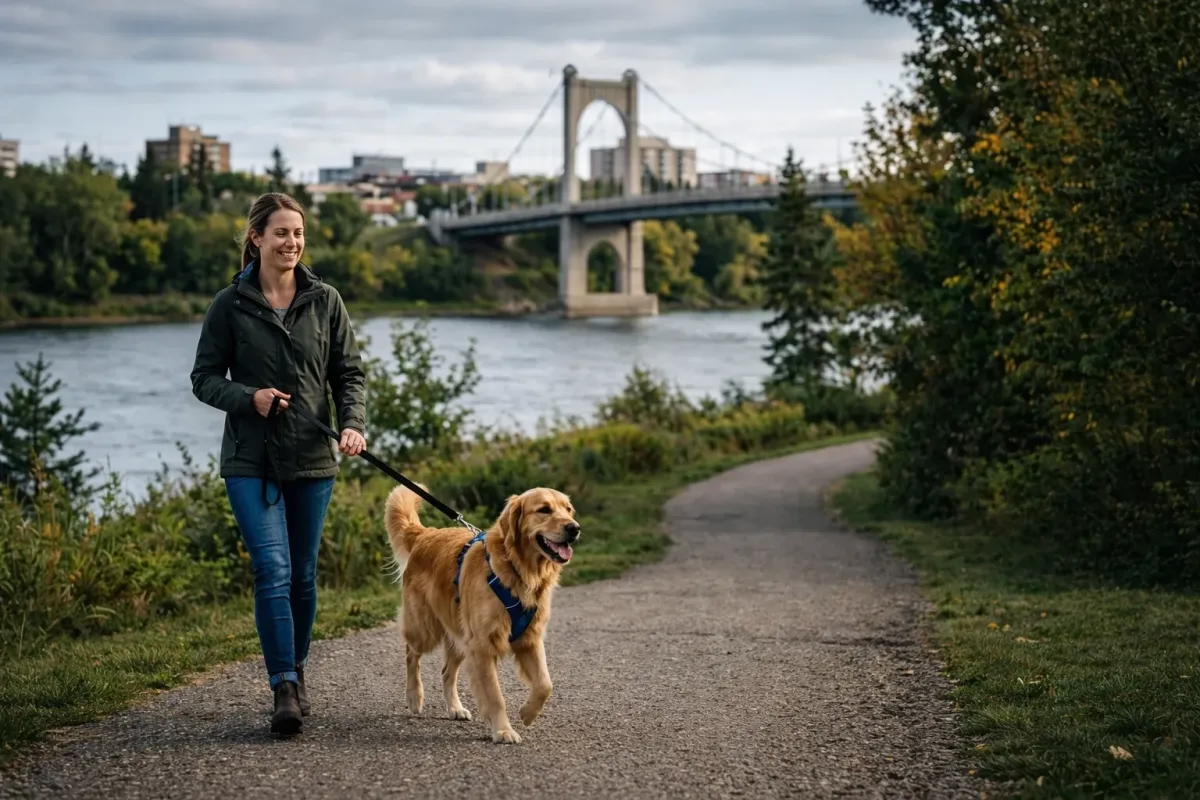
Walking your dog should be the highlight of your day. It’s supposed to be that peaceful moment where you clear your head, your dog gets some fresh air, and you both enjoy the Saskatchewan scenery. But for many dog owners in Prince Albert, the reality is a lot more painful. It’s a constant tug-of-war that leaves your shoulder sore, your patience thin, and your dog gasping for air at the end of a tight lead.
If you feel like you’re being dragged behind a furry freight train every time you step outside, you aren’t alone. Leash pulling is one of the most common complaints we hear at Arsenal Canine Academy. It’s frustrating, and frankly, it can be embarrassing when you’re trying to navigate a busy trail and your dog is lunging at every leaf that blows by.
The good news? It doesn’t have to stay this way. Improving your dog’s leash manners is one of the fastest ways to transform your relationship. With the right approach to leash training in Prince Albert, you can go from being a passenger to being a partner.
Why Does My Dog Pull?
Before we fix the behaviour, we need to understand why it happens. It’s rarely about dominance or your dog "trying to be the boss." Usually, it’s much simpler than that.
First, dogs naturally walk faster than humans. Their comfortable cruising speed is about double ours. When we move at a human pace, we’re essentially asking them to walk in slow motion. Second, dogs have an "opposition reflex." If they feel pressure pulling them back, their natural instinct is to lean into it and pull harder.
Lastly, pulling works. If your dog pulls and you move forward: even just a little bit: they’ve learned that tension on the leash equals progress. They want to get to that fire hydrant or that patch of grass, and pulling is the fastest way to get there. To fix it, we have to change the rules of the game.

The Arsenal Approach: Training Both Ends of the Leash
At Arsenal Canine Academy, we don’t just train dogs; we train handlers. You can have the most obedient dog in the world, but if you don't know how to communicate effectively through the leash, those skills will fall apart the moment a squirrel runs across the path.
Effective leash training in Prince Albert requires a shift in mindset. It’s about building a "conversation" between you and your dog. When the leash goes tight, that conversation stops. When it’s loose, the world opens up. Our Reconstructing Rover program is specifically designed to address these foundational communication gaps, ensuring that both you and your dog are speaking the same language.
Equipment: Choosing the Right Tools
Research shows that using the right equipment can drastically reduce pulling almost immediately. While we don't believe in "magic" gear that fixes everything without training, the right tool makes the training process much smoother.
Training Collars: For some dogs, a well-fitted training collar provides the clear communication they need to understand boundaries.
The 6-Foot Lead: Forget the retractable leashes. They teach dogs that tension is normal and give you zero control. Stick to a standard, high-quality flat leash.
If you’re unsure which tool is right for your specific breed or situation, it might be time to seek a dog behaviour expert.
The Fastest Way to See Results: Start Indoors
Most people make the mistake of trying to teach leash manners in the middle of a high-distraction environment, like a busy park or a street with barking neighbours. That’s like trying to learn algebra at a rock concert.
To get the fastest results, start in your living room. There are no smells, no other dogs, and no distractions. Once your dog can walk perfectly by your side in the kitchen, move to the backyard. Once they master the backyard, move to the driveway. We build success in layers. If you skip the foundation, the whole structure collapses when things get exciting.

Key Exercises for Better Leash Manners
Here are three exercises we use to kickstart progress:
1. The Red Light/Green Light Drill
This is the most direct way to teach your dog that pulling is a dead end.
Green Light: Your dog is on a loose leash? We move forward.
Red Light: The moment there is tension on the leash, you stop dead. Don't yell, don't yank: just become an anchor.
The Reset: Wait for your dog to look back at you or create slack in the leash. Once the leash is loose, the light turns green again.
2. The Attention Game
A dog that is looking at you can’t be pulling away from you. Reward your dog every single time they "check in" during a walk. If they look up at your face, give them praise or some kibble.. Eventually, they’ll start to prioritize your presence over the distractions around them. This is a core part of advanced dog training in Prince Albert.
3. Rapid Changes in Direction
If your dog starts to get ahead of you, simply turn 180 degrees and walk the other way without a word. This teaches the dog that they need to pay attention to where you are going, because you might change course at any second.
High-Frequency Reinforcement
In the beginning, you need to be a "pez dispenser" of rewards. If your dog takes three steps on a loose leash, reward them. We want to heavily reinforce the behaviour we want to see. As the dog gets better, you can start to space those rewards out, but don't be stingy in the early stages.
You’re competing with every smell, sound, and sight in Prince Albert. You have to make being next to you the most rewarding place for your dog to be.

When the Basics Aren't Enough
Sometimes, leash pulling isn't just about excitement; it's a symptom of deeper issues like reactivity or anxiety. If your dog isn't just pulling, but is also lunging, barking, or showing signs of distress, the "stop and go" method might not be enough.
In these cases, specialised intervention is required. Our Boarding Rover program is designed for dogs that need more than just basic obedience. We dig into the "why" behind the behaviour and create a structured plan to rebuild that trust and control. Whether you're dealing with a high-drive working breed or a rescue with a complicated past, we have the experience to handle it.
The Arsenal Results Guarantee
We know that dog training is an investment of your time and money. That’s why at Arsenal Canine Academy, we stand behind our methods. We don't do "fluff" training. We provide no-nonsense, results-oriented coaching that actually works in the real world: not just in a quiet training hall.
We are so confident in our ability to help you and your dog that we offer a results guarantee. If you put in the work and follow the program, you will see a difference in how your dog handles the leash.
Taking the Next Step in Prince Albert
Don’t spend another year being dragged around the block. Leash training isn't just about convenience; it's about safety. A dog that pulls can trip you, pull you into traffic, or break free and get lost.
If you’re ready to stop the pulling and start enjoying your walks again, let’s get to work. From basic manners to breaking through training plateaus, we are here to support the Prince Albert dog community.
Ready to transform your walks? Contact us today to learn more about our training options and how we can help you and your dog achieve the perfect heel. It’s time to take back the leash.
